


I. Introduction:
This term has been nothing short of monumental for our trust and school improvement team. Beyond mere achievements, we faced the challenge of enduring the demanding 9-week Leicestershire half-term. As we near the end of this term, it’s an opportune moment to reflect on the significant positive changes that have been made and how these came about it.
At the term’s outset, two schools in our trust were judged “Requires Improvement.” Today, all schools are judged as “Good” or better. In this blog, I aim to share insights into the transformative journey we undertook to achieve these remarkable improvements.
I cannot overemphasise the invaluable guidance provided by Sir David Carter and Laura McInerney in their book, “Leading Academy Trusts.” The wealth of wisdom and knowledge on school improvement within these pages has served as the cornerstone for much of the work we have done. Most of what you read below is an application of this book.
Before I start it’s essential to note two important caveats:
Caveat 1:
Amidst the current sensitivity surrounding inspections, this blog isn’t about gloating over a specific OFSTED judgement. Instead, it sheds light on how we rapidly improved two schools, focusing on enhancing the student experience (which resulted in a change of OFSTED judgement). Both schools were RI (one double RI) and are now good but this is not the end of the improvement journey for them. Every school, regardless of its current judgement, has room for further improvement, including those that are judged Good or Outstanding.
Caveat 2:
Success is attributed to a collaborative team effort, not any one individual.
II. Foundations for School Improvement:
Cultural Shift:
Recognising that every employee in the Trust is responsible for the education of every student attending one of the Trust schools, we fostered a cultural shift. School improvement became a collective priority, transcending individual school boundaries. What this looked like in reality was skilled leaders from across the Trust leaning in and taking a team around the school approach for the schools needing extra support. There was a growing understanding that if we are doing something at one school that would benefit a group of students attending another school then morally we needed to make that happen for them too. If I’m honest we haven’t got every employee in the Trust to think beyond their own school like this yet, but getting the wider leadership teams on board has been a pivotal change.
Prioritising school improvement:
For school leaders to make a difference they needed to focus their time on school improvement activities. There can be so many demands on school leaders that the things that will have the biggest impact on students get squeezed out. Our central business support team were absolutely key here. More and more administrative and compliance tasks were taken on centrally. This might seem like a loss of control but our leaders found it liberating. They were able to get out of the office and focus on improving teaching and learning. In schools we are very good at adding extra initiatives and strategies. We are not so good at subtracting things that may get in the way as summed up in this fascinating read by Diana Kwon.
Building extra capacity for change at pace:
…that a single day spent by a child in an underperforming schools is a day too many.
Nicky Morgan, 2015
The improvements needed to happen at pace. Both schools have a high percentage of disadvantaged students. Every term the issues were not addressed meant this group of students were being failed. To bring about the improvements at pace we needed to create capacity. This happened in two ways;
- Two executive leaders took a step back from day to day leadership at specific schools to bolster the central school improvement team.
- Partnership with a larger, successful local trust (RISE) via a service level agreement to support aspects of our school improvement strategy. It is my opinion that trust to trust support like this needs to happen more often.
III. The Process:
Once the foundations for school improvement were in place we were able to apply a model for strategic change, brilliantly summarised by John Murphy, former CEO of Oasis Trust. I heard John talk about this process at a School Improvement conference in October 2023 and was struck how succinctly it summed up what we had been doing. The model acts as a framework to explain some of the key actions that took place.
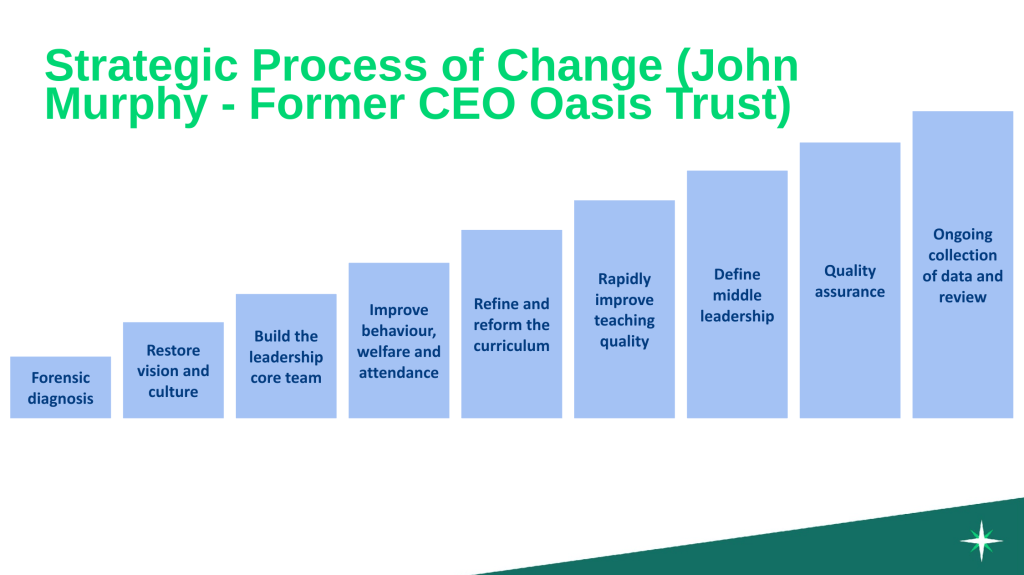
Forensic Diagnosis:
A thorough examination of previous inspections highlighted weaknesses in curriculum development and pedagogical approaches. The school improvement team conducted reviews and spent extensive time within the schools to pinpoint the root causes. This was more complex than first thought – there were some brilliant teachers and skilled support staff.
Restore Vision and Culture:
The key was instilling self belief back into the staff that these schools could be a remarkable asset for their communities. These key messages were communicated with staff, pupils, parents and communities whenever possible, through staff meetings, assemblies, conversations in the corridors and at the school gates.
Improve Behaviour, Welfare, and Attendance:
Expectations of students, in terms of the behaviours required in the classroom and their capacity to achieve, were too low. The schools were safe; fights weren’t breaking out in the dining room and teachers weren’t being verbally abused but what was seen in the classrooms was not helping the students to be highly successful. The Heads of School were supported by the school improvement team to implement a behaviour curriculum. It was down to the individual school leadership teams on how best to do this in their specific context but this standardisation helped accelerate the pace of change. This enabled the school improvement team to provide the bespoke support required to keep things moving forward.
I love visiting both of these schools now. Students are polite, friendly and positive and there is a palpable excited anticipation about learning. This change has been incredible and you feel the difference as soon as you enter the schools.
Refine the Curriculum:
In previous inspections both schools were found to have some holes in the curriculum. The staff teams had spent a lot of time trying to write and refine their curriculum over a number of years. This had tied up a lot of their time and focus but had not been overly successful. It was incredibly difficult for the school improvement team to provide support for schools following different curriculum models. It was particularly difficult to broker school to school support meaning that schools were working in isolation and the best curriculum leaders weren’t able to have an impact beyond their own school. The decision was made to move towards an aligned trust wide curriculum. We were ambitious for our students, schools and community, so after much thought and debate decided to partner with Unity Schools Partnership to implement CUSP (Curriculum of Unity Schools Partnership). This is another brilliant example of trust to trust support that I would love to see happening more. Our students in every school, including very small schools with three teachers, now had access to a high quality curriculum. As part of the service level agreement with RISE one of the schools was supported to deliver the RISE curriculum in some subject areas. Trust leaders were now able to say that every school had a knowledge rich, ambitious, coherently sequenced curriculum with the potential to promote social mobility.
Having access to a brilliant curriculum is one thing, successful implementation is quite another. Transitioning to the very ambitious CUSP curriculum took careful planning to ensure gaps in knowledge weren’t left. It wasn’t all smooth sailing and if we were to do it again there would be things we would change about the implementation process. This project has left a legacy of leaders across the trust with experience implementing the CUSP curriculum so that when other schools need this support the revised implementation model can bring about the improvements at pace.
Rapidly Improve Teaching Quality:
We know that high quality teaching has the most impact on disadvantaged students so needed to ensure the practice seen in the classroom of these two schools at least matched the practice in the best classroom in the trust. Bringing together resources across the Trust enabled us to have a CPD offer that would far exceed what would be possible on an individual school basis. This meant that every three weeks all teachers within the trust came together for CPD delivered as part of a service level agreement. This was followed up in individual schools to help teachers rehearse, embed and refine the practice. The aim was to ensure that all teaching staff were using evidence informed strategies to help their students know more and remember more.
The standardised approach to pedagogy meant that the improvements could be made at pace. Support and development visits from the school improvement team and other staff took on a much sharper focus as everyone began to use the same language and had the same high expectations.
Conclusion:
As mentioned at the beginning of this blog, although the schools are now both recognised as good we want them to be brilliant for their communities and this needs to be sustained long term. Over the coming months there is still more work to do around developing middle leadership and sharpening quality assurance both at school level and trust level. As these schools continue to improve and eventually become capacity givers the journey they have been will provide a vital skill set within the trust and beyond.
 If Not Now, When?
Leave a comment